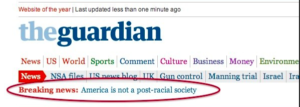
Is our Rhetoric Post Racial Yet?


I will admit that I read articles like Everett’s “Have We Become Postracial Yet?” to dissect how the writer crafts her argument. I am often entertained reading narratives that are crafted with fictitious or hyperbolic diction, leading readers to believe that President Obama somehow rode some glittery white magic carpet into the White house on a wave of social media frenzy.

That he somehow wooed the public with his Harvard educated tongue and blinded the voting citizens of this country with his pearl white teeth so much that they could not neither see his brown skin nor the coffee complexion of his wife and daughters.

The reality is President Obama was not a magical black man. He is like many beautiful black educated men with  beautiful black families. The difference is Barry Obama ran for President of the United States and these aligning elements aided in his victory: (1) the precipice of the social media craze (2) the tragedy that is President George Bush Jr (3) and LARGELY the masses’ perception that President Obama  was nonthreatening and non-black because the media did not project him as the stereotypical “pro-back” or angry black man. President Obama gained global appeal because he was a stark contrast to what media news outlets normally portray. President Obama was likable and electable.

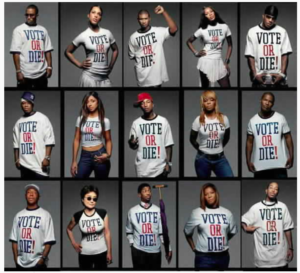
Yes, social media has impacted and continues to impact the presidential campaigns. While there is notable mention of KRS’s appreciation for 2001 use of we “conscious” events, Everett fail to pay homage and give credit to Sean Combs for his 2004 “Vote or Die” campaign that swept the nation, resulting in George Bush Jr.  barely winning his second term against John Kerry.  It was marketing brilliance, igniting a passion among minority voters.

Everette becomes yet another columnist who devalues urban artists’ contributions to the Presidential race while providing several examples of covert racism to remind us why we are not yet living in post racial bliss.

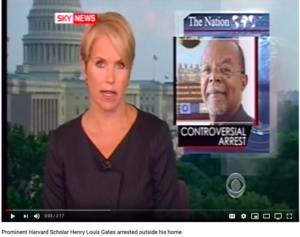
Also, the negative backlash President Obama received following  his public response to the 2009 wrongful arrest of Harvard African American Literature Professor Charles Gates mirrors America’s distrust for black leaders who publicly speak out against the unfair treatment of other black intellects.

Conversely, I do not think there is “fear” of a black President.

I think there is just an ignorance and refusal to accept  there is an actual love and appreciation for BLACK anything …that includes black intellect, black affluence, black  leadership, black unity, black family,  black love, black happiness, black pride,  black beauty….


We are definitely not post-racial!

Tech-savvy youth and not so tech-savvy non-youth have played an integral role in the lack of progress that we’ve made towards becoming post-racial.  The internet and various forms of social media are largely responsible for the spread of information as well as misinformation during the Obama-era.  The fact that the Obama campaign had YouTube and other social media platforms at their disposal was a contributing factor to his being elected during his two historical terms.  They were also contributing factors in his declining favorable poll numbers as well.  One such source was mentioned by Everett on page 159, she references the Andrew Breitbart blog that intentionally spread false information.  The blatant misinformation that was spread by many organizations under the guise of being legitimate unbiased sources is also evidence of our racial shortcomings.  I think that people don’t do their due diligence when reading, and researching topics.  If the motives of the producers of websites, were researched then it would possibly stimulate people to question a lot of the racist propaganda that is often being spread on websites and social media platforms under blatantly deceptive GUIs.  The investigation of reliable sources is a skill taught in seventh grade.  Students are taught to question the motives of the creators and to follow the money trail.  Even when research is conducted the thing that frightens me the most is when people read the information that is obviously false or presented out of context and they still choose to believe the false information and spread it.

Work Cited

Nakamura, Lisa, et al. Race after the Internet. Routledge, 2012. “Have We Become Postracial Yet?”

Coding, Regulating, and Cyberspace

After reading Lessig’s chapters it has become abundantly clear nothing on the internet or cyberspace is private.  There is an absolute absence of the promised freedoms that cyberspace was supposed to provide. According to Lessig, “Cyberspace was, by nature, unavoidably free.  Governments could threaten, but behavior could not be controlled.” (3 Lessig).  I completely disagree with the statement as the government does control our behavior.  Jakes’s story from chapter two is a testament to this.  The government attempted to regulate his behavior when he was arrested for his posts, while Jake was eventually cleared his story most likely served as a cautionary tale for most others. Jake was able to win his case on the principle of first amendment freedom of speech; however, most people are not willing to go through the expense and stress of dealing with the judicial system which in essence is how the government regulates their cyber behavior/presence.

I immediately cleared my cached and cookies after reading about their true intent.  I like most other people (I hope) didn’t really give the acceptance of cookies from websites I visit a second thought.  Now that  I am keenly aware that they are able to track my browsing patterns it is now a habit of mine to clear my cookies on a regular basis.  I have noticed that after visiting the NSU bookstore webpage,  ads that are directed to me are from the NSU bookstore.

I was reminded of the new REAL ID that will soon be required to travel foreign and domestically when I read the section on Identity and Authentication.  While I think the idea of having an ID that I can control the limits on is a great idea, I am still a little skeptical of who will really have full access to all of my information.  I do have a REAL ID, and I applied for it without really questioning it.  I simply did not want to be denied travel access.  I wonder how many other people did not really question the true intent and who exactly would have access to all of the data stored on the REAL ID and for what purpose would they use this information. I feel as though I made the decision to get one because as Lessig states in Chapter 16, I was disabled from having a choice.

Work Cited

Lessig, Lawrence. Code 2.0. Basic Books, 2010. chapters 1-5, 16 http://www.codev2.cc/


Forget Game of Thrones, it’s Game of Owns

ATT vs Hush-a-Phone

Google vs Microsoft

Facebook vs Instagram

Monopolies are as American as apple pie. In fact, one of America’s most popular family games is centered around owning all of the competition and making others pay for services.

He who owns information controls the universe. In regards to the digital universe, Google is Oz, Mark Zuckerberg is sitting behind the green curtain, and we are deciding between which road will take us back to Kansas .

Many of us who were around when the original Facebook launched admired Zuckerberg. Generation X-ers and Millennials regarding him as a business savvy peer who created this platform where college and graduate students could network.

As Facebook became more popular, public and open, we no longer viewed Zuckerberg as a peer.  He is now a business tycoon, eager to monopolize the competition…

What’s the solution for companies who take the monopolistic approach?

Dr. Rufus Pollock suggests regulating and funding. Well, what’s the issue? It’s tricky. First, the minute someone utters the words “regulation” a panic ensues. What will that cost? Does that mean my private information becomes public?

Pollok’s solution is to regulate and fund the software that allow Zuckerberg and Google to be the sole provider of their platforms. Regulating and funding the software will allow the competition access as well so that the public can decide who gives the best option or provides a better service.

Oz is big enough for more than one person to sit behind the green curtain.

Pollock, Rufus. 2018. Open Revolutionhttps://openrevolution.net/media/open-revolution.pdf

Zomorodi, Manoush and Poyant, Jen. 2018. ZigZag Podcast Season 2 Episode 11: If Capitalism and Socialism Had a Baby. https://zigzagpod.com/2018/12/20/s2-ep11-if-capitalism-and-socialism-had-a-baby/

The “Corner Store’s” Demise

Monopolies are a recurring point of contention that seems to rear its ugly head with societal technology changes. Today it’s Google, Facebook, and Amazon. Previously, it was AT&T, Standard Oil, and U.S. Steel. What I found interesting in Pollock’s The Open Revolution was its affect on my perception of a monopoly, and his shift from power in money (although money is a component) to power in attention (his italics). The three mentioned above do indeed monopolize our attention, at least as far as the internet is concerned. (Netflix is also a primary player in attention grabbing, but Amazon is doing what it can to mitigate their power.) If you’re not on all three of the aforementioned platforms, most of us are at least using one. You might not use Facebook or Amazon, but it highly unlikely that you aren’t using Google at least periodically. I couldn’t begin to guess how I often I use Google each week.

Big corporations have changed the physical landscape of America. I first noticed it with corner grocery stores. Growing up in the city there were several small ‘mom and pop’ shops on virtually every corner, but with the increase in mobility and cheaper prices at chain stores, they slowly started to disappear. Now the digital landscape is going through a similar change, not only affecting the online world but also the physical one. Big digital companies are absorbing, and sometimes cannibalizing, small endeavors online just like corner stores were lost to the chain takeover, but is an “Open World” (5) the answer?

“In an Open world we would pay innovators and creators more and more fairly, using market-driven remuneration rights in place of intellectual property monopoly rights” (7). Pollack speaks of Artificial Intelligence (AI) using machines to eliminate mundane tasks (jobs) to free up our time for more pleasant things. The idea sounds fantastic, but with all the technological innovations we have already instilled to make our lives easier, we have only found ourselves busier. The washing machine, the dishwasher, the car, all provide easier means with which to accomplish these mindless chores, or decrease travel time, and yet we are more time-starved than ever. In addition, if AI eliminates some of the work venues or relegates the human labor pool to people vying for a limited amount of jobs, we may find ourselves still, maybe even deeper into a monopoly. A monopoly of another name, or with another mission, yet still is a big corporation that leaves the little guy in the dust.

Leaving Facebook and the ambivalence associated with leaving.

After reading about the Cambridge Analytica scandal any ambivalence that I felt in regards to Facebook is all but gone. Even prior to reading about the scandal I was paranoid enough to add only the required information when I set up my mandated work account. I have zero interest in being “discovered” by old acquaintances, schoolmates, co-workers and etc.  Jeong’s article served to substantiate my claims that Facebook and many of the other various social media platforms only serve to stunt social skills.  Her mention of students suspending their accounts during finals also proves that often times people will neglect responsibilities in the name of social media because apparently, it is just that addictive. They cannot trust themselves enough to stay away even when the stakes are obviously high.

I found humor in the Facebook security teams dodging responsibility in that they did not do any investigative work before verifying her account, instead, they called their error in judgment a,  “bug discovery”.  I would definitely be someone that would never have a verified account even with millions of followers because I feel as though the verification process would make me vulnerable to being hacked.

Work Cited

      Jeong, Sarah. “I Tried Leaving Facebook. I Couldn’t.” The Verge, The Verge, 28 Apr. 2018, www.theverge.com/2018/4/28/17293056/facebook-deletefacebook-social-network-monopoly.

Can information ever be free?

Jeong tried leaving Facebook but couldn’t. Why? Was it because there was too much free information?

When Pollock wants creators to be rewarded through a collective of sorts, but it doesn’t seem to happen … why? Is it because we like the current system?

It’s interesting to think that we have found ourselves at a crossroads between information, capitalism, freedom, monopoly, privacy, publicity, rights, social needs, and identity. There’s a lot going on. Yet a common thread emerges.

Pollock’s utopian-ish assertion that creators should monetarily benefit from their work through a tax-funded system arbitrated by a government body that divvies rewards based upon value seems a stretch to accomplish. It’s not impossible. Marx would agree (and I don’t write that with Libertarian disdain). The workers put forth their work for the good of all. The workers get paid their portion.

Pollock makes a sound argument that government is already established and, to a large degree, trusted (for lack of a better word). He logically posits that this body is already bestowed by the people with the powers to perform the function of rewarding creators so that information could be free. That free-flowing information might accelerate the cross-pollination of ideas, inventions, cures, and more. It’s a grand and beautiful vision.

There is one problem.

Capitalism outpaces this idea with the promise of winning. (Not in the Charlie Sheen sense of winning, but not far off.) Something interesting was birthed during the great experiment that became the United States and spread to other countries. Perhaps intentionally, capitalist concepts tapped into a deep-seeded desire to achieve and, through the course of decades, that desire seems to have proven itself more resilient, more innately human than cooperativeness and greater-good concepts. It fuels itself, after all, with stories of success publicized now constantly in every minute of our day.

When the evolution of computers and the internet and cell phones and data meets capitalist concepts, we get Facebook. After all, it’s a place where the information appears free. It’s volunteered, at least. The creators are being rewarded with a service that makes their lives easier, as Jeong attests. Facebook rewards participants with a service they want. Facebook is rewarded for selling the information users provide.

At first read, Pollock and Jeong appear to be talking about separate things. Pollock describes information of value to society. Jeong describes information of value to the singular person. Both are commoditized in our digital economy. Societal information is copyrighted, patented, and held secret to be sold and licensed under contract … because the creators (or the creators’ employers) understand its intrinsic value. Personal information is volunteered on social networks without much thought … because the creators see it as having little value.

The two concepts, set within the current context of a senator’s recent push to breakup platforms on the basis of antitrust law and the European Union’s passage of General Data Protection Regulation (GDPR), appear to be fusing. If history is our teacher (though it’s arguable if we ever learn from it), the ability of capitalist societies to evolve may be one of their core strengths.

When the government protects the data privacy of its citizens, do the citizens then see it as valuable? Is that what it takes? It might be easy, after all, to imagine the trial lawyer commercials asking us to join class action suits due to a breach in our privacy. Those commercials would pin a numerical value on how much our data is worth as they promise us settlement money. Would Facebook then pay us to participate?

I’m not sure this scenario is any more likely than voiding copyright law with the promise of dividends paid to creators. But some scenario must play out.

It makes me wonder, has an entrepreneurial wiz already imagined ways to capitalize on data from the consumer perspective? Are we looking toward a world that offers us free devices and credits in exchange for being analyzed?

The Europeans have historically been able to take U.S. ideas and build hybrid versions that reap the benefits of capitalist and socialist concepts. GDPR fits within that notion. Within that framework, companies are free to do business, but individual privacy has value.

State side, a similar set of ideas is gaining a political toehold. Social capitalists are winning office and winning audiences. We have yet to see if they’ll win houses of congress, judicial seats, and the ever-coveted bully pulpit.

All the while, Chinese and Russian citizens are portrayed as people who have very little freedom. This is true in many respects, especially when it comes to politics. But if they were free, would that mean they could post whatever they want on Facebook? Is that really freedom?

Pollock’s ideas ring nothing short of noble in spirit. Jeong’s laments are tangible and real. Both authors describe information as something of value.

Reading Pollock makes me want to send thank you notes to every person who has ever created a seed bank, fought for public water rights, and cleaned a national park. Reading Jeong makes me want to quit Facebook (and I already have).

I work in a global company where GDPR has had a tremendous impact on the way it conducts business. Changing the laws has an impact. Will it take changing laws to remind citizens that their data has value?

When citizens see that their data has value, can it ever be free?


References

Pollock, Rufus. 2018. Open Revolution. https://openrevolution.net/media/open-revolution.pdf

Jeong, Sarah. 2018. “I tried leaving Facebook. I couldn’t.” The Verge.  https://www.theverge.com/2018/4/28/17293056/facebook-deletefacebook-social-network-monopoly
Fair play in the Digital World

After listening to Zomordi and Poyant’s podcast I am convinced that there probably never be fair play in the digital world.  As long as our government seeks to regulate as opposed to moving to a required open data/source movement the larger companies will continue to amass more wealth and influence which in turn will allow them to gobble up their competition.  I agree with Rufus when he proposed his version of a competitive market by having digital companies open their software to even the playing field.  I just don’t think that that will ever happen.

His example of a demand-driven market seemed akin to meritocracy.  I’m all for a demand-driven market and having the best producer of a service compensated for their work if the playing field is even.  Thinking of an even playing field I can recall working for a mobile company when it was in the process of acquiring one of its competitors and one of their marketing strategies was to persuade customers of their competitor that this acquisition would greatly benefit them.  The truth is that the customers did not receive better service the acquisition was simply embarked upon to do as Rufus stated to neutralize their competition.  New services and products were not implemented, there was zero innovation.  In fact, the customers of the acquired company actually lost many of the perks that they enjoyed prior to the acquisition.

Work Cited

Zomorodi, Manoush and Poyant, Jen. 2018. ZigZag Podcast Season 2 Episode 11: If Capitalism and Socialism Had a Baby.  https://zigzagpod.com/2018/12/20/s2-ep11-if-capitalism-and-socialism-had-a-baby/

Is Meritocracy Real?

I don’t think that meritocracy is a legitimate term.  In the previous chapters, this term was debunked before it was even discussed.  In order to have the best and the brightest everyone has to have the same opportunity to access the education required to be the best and the brightest.  Clearly, ambition is not always taken into account when assigning such titles.  I think that this term is simply “corporate speak” for we tried.

Work Cited

Wachter-Boettcher, Sara. Technically Wrong: Sexist Apps, Biased Algorithms, and Other Threats of Toxic Tech. W.W. Norton and Company, 2018.  Chapter 9

Hackers Ethic?

When I think of hackers I think of someone hiding in a dark room, in an undisclosed location.  I think that most people may share this same vision.  Hackers are seen by most as some sort of illicit hobby.  Naturally, I was intrigued by this article.  Hackers in general usually invoke some sort of fear in most people.  They give people a sense of insecurity, we feel vulnerable. Parrish sought to normalize the role of hackers in a sense.  She went as far as to revise the ethics of a hacker.

There was one section that I could completely identify with, and this was the section that mentioned transcription.  I have a little experience with a couple of transcription apps.  I used them last semester to transcribe interviews, and I completely agree that transcribing is not an exact science so to speak.  I found that the diction, dialect, rate, pitch, and inflection made the transcription process difficult for the apps that I used.

Work Cited

     Parrish, Allison. 2016. “Programming is Forgetting: Toward a New Hacker Ethic.” Open Hardware Summit presentation