
Are Digital Trends Infiltrating our Ethical “Firewalls”?
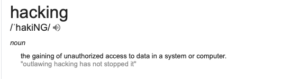
Parish praises Steven Levy, the author of Hackers: Heroes of the Computer Revolution. Although he uses the term loosely in efforts to draw readers in to purchase a book or enroll in a course about computer programming, I found the negative connotation followed by Hacker Ethics ironic and somewhat problematic:
- Access to computers should be unlimited and total.
- All information should be free.
- Mistrust authority—promote decentralization.
- Hackers should be judged by their hacking, not bogus criteria such as degrees, age, race or position.
- You can create art and beauty on a computer.
- Computers can change your life for the better.
Since the early 80s, computer hacking has cost companies millions each year and has even resulted in violations of consumer privacy. And here we are….
Although, I agree that continuous computer programming is necessary. There is value in taking systems apart and understanding how they work. However, in this social media climate where things are easily taken out of context, over looked, underestimated, and under-researched, a brief education to the masses on what constitutes as legal computer activity would add value to this article as well.
Because social media encourages people to share information, even students as young as middle schoolers are encouraged to be digital citizens who comment on cultural, social, and political concerns in global and local communities.
Likewise, Beck’s article focus on expanding rhetoric and composition so that that students can explore writing for digital algorithmic surveillance trends. On one hand, this makes sense. Beck makes strong arguments. By drawing attention to student participation in computer-mediated environments, we are able expose the inequalities that thrive in online spaces.
One the other hand, personalized and self-generated algorithms store one sided information over time, thus deeming the data harvested limited, biased, and onside. This would also limit a person’s ability to view political, social, and cultural ideas objectively.
There are no shortages of one sided views and rhetoric; however, responsible instruction and critically analysis of the legitimacy of rhetoric is always valuable to the composition community.
Beck, E. (2017). “Sustaining Critical Literacies in the Digital Information Age: The Rhetoric of Sharing, Prosumerism, and Digital Algorithmic Surveillance.” Retrieved from https://wac.colostate.edu/books/social/chapter2.pdf
Parrish, A. (2016). “Programming is Forgetting: Toward a New Hacker Ethic.” Open Hardware Summit presentation. Retrieved from http://opentranscripts.org/transcript/programming-forgetting-new-hacker-ethic/
Wachter-Boettcher, S. (2017). Technically Wrong: Sexist Apps, Biased Algorithms, and other Threads of Toxic Tech.)
you’re right that many digital platforms are enabling very young people to take on public roles as citizens and “influencers” to some extent. I’m reminded of the news about Teen Vogue covering heavy political and social topics, and many people being surprised they didn’t stick to fashion and make-up and whatnot.
I want to challenge you to revisit the transcript of Parish’s talk and consider whether she is truly praising Levy’s “hacker ethic” as much as your summary here claims. I find her comments on these principles much more nuanced.