
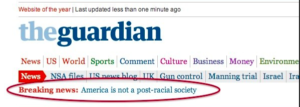
I will admit that I read articles like Everett’s “Have We Become Postracial Yet?” to dissect how the writer crafts her argument. I am often entertained reading narratives that are crafted with fictitious or hyperbolic diction, leading readers to believe that President Obama somehow rode some glittery white magic carpet into the White house on a wave of social media frenzy.
That he somehow wooed the public with his Harvard educated tongue and blinded the voting citizens of this country with his pearl white teeth so much that they could not neither see his brown skin nor the coffee complexion of his wife and daughters.
The reality is President Obama was not a magical black man. He is like many beautiful black educated men with beautiful black families. The difference is Barry Obama ran for President of the United States and these aligning elements aided in his victory: (1) the precipice of the social media craze (2) the tragedy that is President George Bush Jr (3) and LARGELY the masses’ perception that President Obama was nonthreatening and non-black because the media did not project him as the stereotypical “pro-back” or angry black man. President Obama gained global appeal because he was a stark contrast to what media news outlets normally portray. President Obama was likable and electable.
Yes, social media has impacted and continues to impact the presidential campaigns. While there is notable mention of KRS’s appreciation for 2001 use of we “conscious” events, Everett fail to pay homage and give credit to Sean Combs for his 2004 “Vote or Die” campaign that swept the nation, resulting in George Bush Jr. barely winning his second term against John Kerry. It was marketing brilliance, igniting a passion among minority voters.
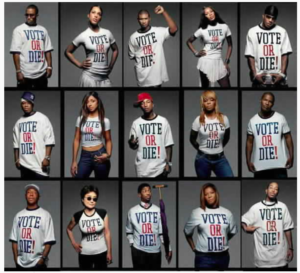
Everette becomes yet another columnist who devalues urban artists’ contributions to the Presidential race while providing several examples of covert racism to remind us why we are not yet living in post racial bliss.
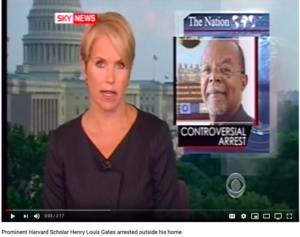
Also, the negative backlash President Obama received following his public response to the 2009 wrongful arrest of Harvard African American Literature Professor Charles Gates mirrors America’s distrust for black leaders who publicly speak out against the unfair treatment of other black intellects.
Conversely, I do not think there is “fear” of a black President.
I think there is just an ignorance and refusal to accept there is an actual love and appreciation for BLACK anything …that includes black intellect, black affluence, black leadership, black unity, black family, black love, black happiness, black pride, black beauty….
great points, Naderia. you’ve added some depth and nuance to this really important topic.
I am especially going to keep thinking about the contrast you present at the end here– not fear of blackness, but a resistance to appreciate blackness as good or admirable. this reminds me of a conversation I see happening about replacing “-phobia” words (homophobia, islamophobia, etc.) when we talk about bigotry. to talk about “fear” or “phobia” could be seen as a way of justifying the bigotry and hatred. as if to say “well, if it’s fear, then they can’t help it– fear is a strong emotion, after all.”
I’ve seen some scholars and activists move toward “-misia” (from the greek for “hate” or “hater”) as a new, more accurate suffix. what do you think?
I missed this comment! That’s a very good question.
I am leery of generalizations and I believe in nuanced thinking. Neither phobia (psychological paralyzing fear) nor ‘misia applies. Honestly, I am not versed in bigotry and prejudiced thinking/behaviors enough to understand, so I do not think the suffix matters. People believe what they want for different reasons.
I DO think that other races are have been forced to believe ideas and perceptions of “white rightness” and “white perfection”, so any rhetoric or narrative that counters that unfairly becomes “anti-white” rhetoric.
That is why I said that there is a refusal to accept that Black people may actually LOVE themselves…